
Welcome to Leo Dent
DIAGNOSTICS
Give health to yourself and your family
We preserve family smiles – an individual approach and a full range of dental services for each member of your family.
SERVICES
Diagnostics
Dental diagnostics is the process of examining the condition of the teeth, gums, oral cavity and bite in order to identify possible diseases, defects or other problems in dentistry. It is an important step in ensuring dental health and planning the necessary treatment.
Dental diagnostics is a key step in maintaining oral health, as it allows you to detect diseases at early stages, when their treatment is the least invasive and effective. A timely examination helps prevent problems such as tooth decay, periodontitis, root inflammation, or malocclusion, which can lead to tooth loss or serious complications. In addition, thanks to modern diagnostic methods, the dentist can get a complete picture of the condition of the teeth, gums and bone tissue, which is the basis for developing an individual treatment plan.
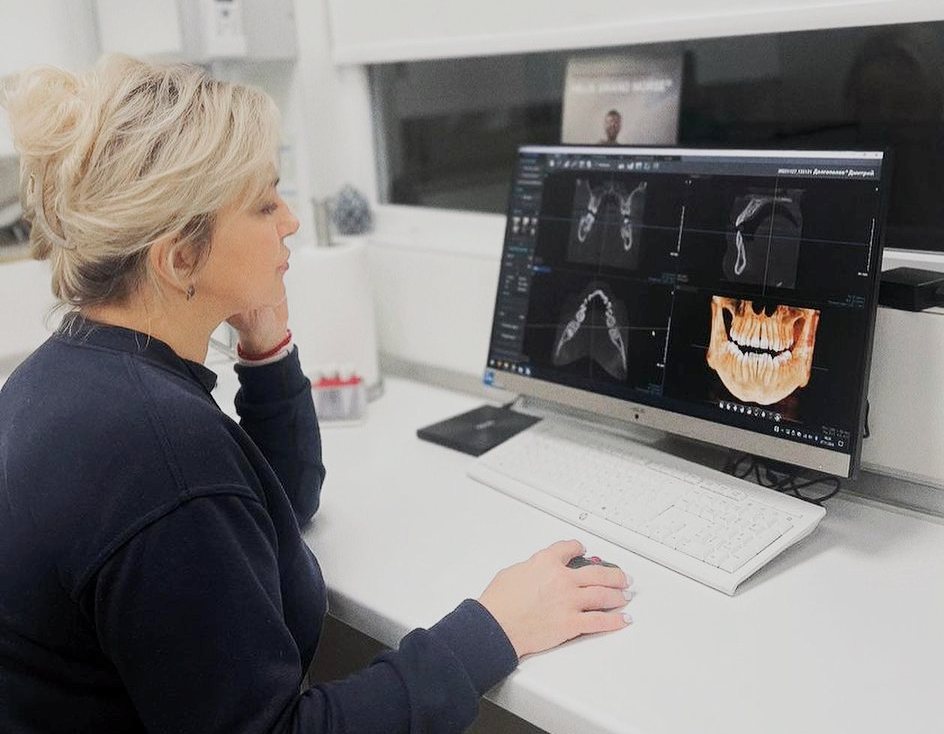
In our clinic, dental diagnostics is carried out using modern methods such as computed tomography (CT) and panoramic images. The difference between computed tomography and panoramic dental X-ray is that in the first version, the image can be viewed from any angle, decomposed into layers, and more detailed information about the state of the structure of the area under study can be obtained. Often, after a panoramic image, the patient still has to undergo computed tomography, but the doctor will decide what exactly is needed in your clinical case.
A panoramic radiography, also called a panoramic X-ray, is a two-dimensional (2-D) dental X-ray examination that captures the entire mouth in one image, including the teeth, upper and lower jaws, and surrounding structures and tissues. The jaw is a curved structure similar to a horseshoe. However, a panoramic X-ray creates a flat image of the curved structure. It usually contains details of bones and teeth. X-ray examination helps doctors diagnose and treat diseases. It exposes you to a small dose of ionizing radiation to create an image of the inside of your body. X-rays are the oldest and most commonly used type of medical imaging. Unlike a traditional intraoral X-ray, where the film/X-ray detector is placed inside the mouth, the film for a panoramic X-ray is placed inside the device.
A dental cone beam computed tomography (CT) scanner is a special type of X-ray machine that is used in situations where regular X-rays of the teeth or face are not sufficient. It is not used regularly because the radiation exposure from this scanner is much higher than a regular dental X-ray. This type of CT scanner uses a special technology to create three-dimensional (3-D) images of the structures of the teeth, soft tissues, nerve pathways and bones in the craniofacial area in one scan. Images obtained with cone beam CT allow for more accurate treatment planning. Cone beam CT scan is not the same as conventional CT scan. However, cone beam CT scans of teeth can be used to obtain images similar to those obtained with conventional CT scans.
With a cone beam CT scan, an X-ray beam in the shape of a cone moves around the patient, creating a large number of images, also called views. Both computed tomography and cone beam computed tomography produce high-quality images. Dental cone beam CT was developed as a means of producing similar types of images, but with a much smaller and less expensive machine that could be placed in an outpatient office. Cone beam CT provides detailed images of bone and is performed to evaluate diseases of the jaw, dentition, facial bone structures, nasal cavity, and sinuses. It does not provide the full diagnostic information available with conventional CT, especially for evaluating soft tissue structures such as muscles, lymph nodes, glands, and nerves. However, cone beam CT has the advantage of lower radiation exposure compared to conventional CT.
|
Procedure
|
Approx. Dose (µSv)
|
Equivalent in days of natural background
|
|---|---|---|
|
Panoramic X-ray
|
10–30 µSv
|
1–3 days
|
|
Cone Beam CT
|
30–200 µSv
|
3–20 days
|
X-ray examinations, in particular cone beam computed tomography (CT) and panoramic X-ray, have a number of advantages. The focused X-ray beam in a CT scan reduces radiation scattering, which ensures high image quality. A single scan creates a wide range of angles and angles, which allows you to get a complete assessment of the condition of bones and soft tissues. CT scan provides more information than conventional X-ray, which helps to plan treatment more accurately. Both methods are painless, non-invasive and accurate, and no radiation remains in the body after the procedure. Panoramic X-rays are especially useful for dental diagnostics and can be used even for young children, as they do not require the placement of a film in the mouth.
Despite the benefits, there are certain risks associated with radiation exposure. Although X-rays in the normal diagnostic range usually have no side effects, there is always a small chance of developing cancer due to excessive radiation exposure. However, the benefits of an accurate diagnosis far outweigh the potential risks. Particular attention should be paid to children who are more sensitive to radiation-CT should be performed only when absolutely necessary, using low-dose technology. Women who may be pregnant should always inform their doctor before undergoing the examination.
Panoramic X-ray examination and CT examination do not require any special preparation. Before the procedure, you may be asked to remove metal objects such as jewelry, glasses, hairpins, hearing aids, or removable dentures to avoid interference with the image. Women should inform their doctor if there is a possibility of pregnancy, as during pregnancy, X-ray examinations are performed only when absolutely necessary with additional precautions to protect the fetus.
X-rays are a form of radiation, like light or radio waves. X-rays pass through most objects, including the body. The technologist carefully directs the X-ray beam to the area of interest. The machine creates a small amount of radiation that passes through your body. The radiation records the image on a photographic film or a special detector. During a panoramic X-ray examination, the X-ray tube rotates in a semicircle around the patient’s head, starting on one side of the jaw and ending on the other side. Instead of relying on a film placed inside the mouth, a panoramic X-ray machine projects a beam through the patient onto a film or detector rotating in front of the X-ray tube. Most x-ray images are digital files stored electronically. Your dentist can easily access these stored images to diagnose and monitor your condition. The digital format also allows your dentist to adjust and change the contrast, brightness, and darkness of the image to better visualize certain structures and tissues. Images on film cannot be adjusted or altered.
You will be positioned in the center of the unit where the technician will carefully position and secure your head. The unit can be adjusted to accommodate a patient standing or sitting in a wheelchair. A bite blocker is then placed in the mouth to ensure that the teeth are positioned correctly. Correct positioning of the teeth and head is important to obtain a clear image. You will be asked to remain very still while a rotating arm moves in a semicircle around the perimeter of your head and images are taken. This can usually take 12 to 20 seconds.
During a CT scan, the C-arm rotates 360 degrees around the head while capturing multiple images from different angles, which are reconstructed to create a single 3-D image. The X-ray source and detector are mounted on opposite sides of the rotating C-arm or gantry and rotate in unison. In a single rotation, the detector can generate 150 to 200 high-resolution two-dimensional (2-D) images, which are then digitally combined to form a 3-D image that can provide your dentist or surgeon with valuable information about your oral health.
DIAGNOSTICS
Prices
-
Consultation450.00 ₴
-
Panoramic shot500.00 ₴
-
Computed tomography1000.00 ₴
Welcome to Leo Dent
Give health to yourself and your family
We preserve family smiles – an individual approach and a full range of dental services for each member of your family.
SERVICES
Diagnostics
Dental diagnostics is the process of examining the condition of the teeth, gums, oral cavity and bite in order to identify possible diseases, defects or other problems in dentistry. It is an important step in ensuring dental health and planning the necessary treatment.
Dental diagnostics is a key step in maintaining oral health, as it allows you to detect diseases at early stages, when their treatment is the least invasive and effective. A timely examination helps prevent problems such as tooth decay, periodontitis, root inflammation, or malocclusion, which can lead to tooth loss or serious complications. In addition, thanks to modern diagnostic methods, the dentist can get a complete picture of the condition of the teeth, gums and bone tissue, which is the basis for developing an individual treatment plan.
In our clinic, dental diagnostics is carried out using modern methods such as computed tomography (CT) and panoramic images. The difference between computed tomography and panoramic dental X-ray is that in the first version, the image can be viewed from any angle, decomposed into layers, and more detailed information about the state of the structure of the area under study can be obtained. Often, after a panoramic image, the patient still has to undergo computed tomography, but the doctor will decide what exactly is needed in your clinical case.
A panoramic radiography, also called a panoramic X-ray, is a two-dimensional (2-D) dental X-ray examination that captures the entire mouth in one image, including the teeth, upper and lower jaws, and surrounding structures and tissues. The jaw is a curved structure similar to a horseshoe. However, a panoramic X-ray creates a flat image of the curved structure. It usually contains details of bones and teeth. X-ray examination helps doctors diagnose and treat diseases. It exposes you to a small dose of ionizing radiation to create an image of the inside of your body. X-rays are the oldest and most commonly used type of medical imaging. Unlike a traditional intraoral X-ray, where the film/X-ray detector is placed inside the mouth, the film for a panoramic X-ray is placed inside the device.
A dental cone beam computed tomography (CT) scanner is a special type of X-ray machine that is used in situations where regular X-rays of the teeth or face are not sufficient. It is not used regularly because the radiation exposure from this scanner is much higher than a regular dental X-ray. This type of CT scanner uses a special technology to create three-dimensional (3-D) images of the structures of the teeth, soft tissues, nerve pathways and bones in the craniofacial area in one scan. Images obtained with cone beam CT allow for more accurate treatment planning. Cone beam CT scan is not the same as conventional CT scan. However, cone beam CT scans of teeth can be used to obtain images similar to those obtained with conventional CT scans.
With a cone beam CT scan, an X-ray beam in the shape of a cone moves around the patient, creating a large number of images, also called views. Both computed tomography and cone beam computed tomography produce high-quality images. Dental cone beam CT was developed as a means of producing similar types of images, but with a much smaller and less expensive machine that could be placed in an outpatient office. Cone beam CT provides detailed images of bone and is performed to evaluate diseases of the jaw, dentition, facial bone structures, nasal cavity, and sinuses. It does not provide the full diagnostic information available with conventional CT, especially for evaluating soft tissue structures such as muscles, lymph nodes, glands, and nerves. However, cone beam CT has the advantage of lower radiation exposure compared to conventional CT.
|
Procedure
|
Approx. Dose (µSv)
|
Equivalent in days of natural background
|
|---|---|---|
|
Panoramic X-ray
|
10–30 µSv
|
1–3 days
|
|
Cone Beam CT
|
30–200 µSv
|
3–20 days
|
X-ray examinations, in particular cone beam computed tomography (CT) and panoramic X-ray, have a number of advantages. The focused X-ray beam in a CT scan reduces radiation scattering, which ensures high image quality. A single scan creates a wide range of angles and angles, which allows you to get a complete assessment of the condition of bones and soft tissues. CT scan provides more information than conventional X-ray, which helps to plan treatment more accurately. Both methods are painless, non-invasive and accurate, and no radiation remains in the body after the procedure. Panoramic X-rays are especially useful for dental diagnostics and can be used even for young children, as they do not require the placement of a film in the mouth.
Despite the benefits, there are certain risks associated with radiation exposure. Although X-rays in the normal diagnostic range usually have no side effects, there is always a small chance of developing cancer due to excessive radiation exposure. However, the benefits of an accurate diagnosis far outweigh the potential risks. Particular attention should be paid to children who are more sensitive to radiation-CT should be performed only when absolutely necessary, using low-dose technology. Women who may be pregnant should always inform their doctor before undergoing the examination.
Panoramic X-ray examination and CT examination do not require any special preparation. Before the procedure, you may be asked to remove metal objects such as jewelry, glasses, hairpins, hearing aids, or removable dentures to avoid interference with the image. Women should inform their doctor if there is a possibility of pregnancy, as during pregnancy, X-ray examinations are performed only when absolutely necessary with additional precautions to protect the fetus.
X-rays are a form of radiation, like light or radio waves. X-rays pass through most objects, including the body. The technologist carefully directs the X-ray beam to the area of interest. The machine creates a small amount of radiation that passes through your body. The radiation records the image on a photographic film or a special detector. During a panoramic X-ray examination, the X-ray tube rotates in a semicircle around the patient’s head, starting on one side of the jaw and ending on the other side. Instead of relying on a film placed inside the mouth, a panoramic X-ray machine projects a beam through the patient onto a film or detector rotating in front of the X-ray tube. Most x-ray images are digital files stored electronically. Your dentist can easily access these stored images to diagnose and monitor your condition. The digital format also allows your dentist to adjust and change the contrast, brightness, and darkness of the image to better visualize certain structures and tissues. Images on film cannot be adjusted or altered.
You will be positioned in the center of the unit where the technician will carefully position and secure your head. The unit can be adjusted to accommodate a patient standing or sitting in a wheelchair. A bite blocker is then placed in the mouth to ensure that the teeth are positioned correctly. Correct positioning of the teeth and head is important to obtain a clear image. You will be asked to remain very still while a rotating arm moves in a semicircle around the perimeter of your head and images are taken. This can usually take 12 to 20 seconds.
During a CT scan, the C-arm rotates 360 degrees around the head while capturing multiple images from different angles, which are reconstructed to create a single 3-D image. The X-ray source and detector are mounted on opposite sides of the rotating C-arm or gantry and rotate in unison. In a single rotation, the detector can generate 150 to 200 high-resolution two-dimensional (2-D) images, which are then digitally combined to form a 3-D image that can provide your dentist or surgeon with valuable information about your oral health.
DIAGNOSTICS
Prices
-
Consultation450.00 ₴
-
Panoramic shot500.00 ₴
-
Computed tomography1000.00 ₴
Welcome to Leo Dent
Give health to yourself and your family
We preserve family smiles – an individual approach and a full range of dental services for each member of your family.
SERVICES
Diagnostics
Dental diagnostics is the process of examining the condition of the teeth, gums, oral cavity and bite in order to identify possible diseases, defects or other problems in dentistry. It is an important step in ensuring dental health and planning the necessary treatment.
Dental diagnostics is a key step in maintaining oral health, as it allows you to detect diseases at early stages, when their treatment is the least invasive and effective. A timely examination helps prevent problems such as tooth decay, periodontitis, root inflammation, or malocclusion, which can lead to tooth loss or serious complications. In addition, thanks to modern diagnostic methods, the dentist can get a complete picture of the condition of the teeth, gums and bone tissue, which is the basis for developing an individual treatment plan.
In our clinic, dental diagnostics is carried out using modern methods such as computed tomography (CT) and panoramic images. The difference between computed tomography and panoramic dental X-ray is that in the first version, the image can be viewed from any angle, decomposed into layers, and more detailed information about the state of the structure of the area under study can be obtained. Often, after a panoramic image, the patient still has to undergo computed tomography, but the doctor will decide what exactly is needed in your clinical case.
A panoramic radiography, also called a panoramic X-ray, is a two-dimensional (2-D) dental X-ray examination that captures the entire mouth in one image, including the teeth, upper and lower jaws, and surrounding structures and tissues. The jaw is a curved structure similar to a horseshoe. However, a panoramic X-ray creates a flat image of the curved structure. It usually contains details of bones and teeth. X-ray examination helps doctors diagnose and treat diseases. It exposes you to a small dose of ionizing radiation to create an image of the inside of your body. X-rays are the oldest and most commonly used type of medical imaging. Unlike a traditional intraoral X-ray, where the film/X-ray detector is placed inside the mouth, the film for a panoramic X-ray is placed inside the device.
A dental cone beam computed tomography (CT) scanner is a special type of X-ray machine that is used in situations where regular X-rays of the teeth or face are not sufficient. It is not used regularly because the radiation exposure from this scanner is much higher than a regular dental X-ray. This type of CT scanner uses a special technology to create three-dimensional (3-D) images of the structures of the teeth, soft tissues, nerve pathways and bones in the craniofacial area in one scan. Images obtained with cone beam CT allow for more accurate treatment planning. Cone beam CT scan is not the same as conventional CT scan. However, cone beam CT scans of teeth can be used to obtain images similar to those obtained with conventional CT scans.
With a cone beam CT scan, an X-ray beam in the shape of a cone moves around the patient, creating a large number of images, also called views. Both computed tomography and cone beam computed tomography produce high-quality images. Dental cone beam CT was developed as a means of producing similar types of images, but with a much smaller and less expensive machine that could be placed in an outpatient office. Cone beam CT provides detailed images of bone and is performed to evaluate diseases of the jaw, dentition, facial bone structures, nasal cavity, and sinuses. It does not provide the full diagnostic information available with conventional CT, especially for evaluating soft tissue structures such as muscles, lymph nodes, glands, and nerves. However, cone beam CT has the advantage of lower radiation exposure compared to conventional CT.
|
Procedure
|
Approx. Dose (µSv)
|
Equivalent in days of natural background
|
|---|---|---|
|
Panoramic X-ray
|
10–30 µSv
|
1–3 days
|
|
Cone Beam CT
|
30–200 µSv
|
3–20 days
|
X-ray examinations, in particular cone beam computed tomography (CT) and panoramic X-ray, have a number of advantages. The focused X-ray beam in a CT scan reduces radiation scattering, which ensures high image quality. A single scan creates a wide range of angles and angles, which allows you to get a complete assessment of the condition of bones and soft tissues. CT scan provides more information than conventional X-ray, which helps to plan treatment more accurately. Both methods are painless, non-invasive and accurate, and no radiation remains in the body after the procedure. Panoramic X-rays are especially useful for dental diagnostics and can be used even for young children, as they do not require the placement of a film in the mouth.
Despite the benefits, there are certain risks associated with radiation exposure. Although X-rays in the normal diagnostic range usually have no side effects, there is always a small chance of developing cancer due to excessive radiation exposure. However, the benefits of an accurate diagnosis far outweigh the potential risks. Particular attention should be paid to children who are more sensitive to radiation-CT should be performed only when absolutely necessary, using low-dose technology. Women who may be pregnant should always inform their doctor before undergoing the examination.
Panoramic X-ray examination and CT examination do not require any special preparation. Before the procedure, you may be asked to remove metal objects such as jewelry, glasses, hairpins, hearing aids, or removable dentures to avoid interference with the image. Women should inform their doctor if there is a possibility of pregnancy, as during pregnancy, X-ray examinations are performed only when absolutely necessary with additional precautions to protect the fetus.
X-rays are a form of radiation, like light or radio waves. X-rays pass through most objects, including the body. The technologist carefully directs the X-ray beam to the area of interest. The machine creates a small amount of radiation that passes through your body. The radiation records the image on a photographic film or a special detector. During a panoramic X-ray examination, the X-ray tube rotates in a semicircle around the patient’s head, starting on one side of the jaw and ending on the other side. Instead of relying on a film placed inside the mouth, a panoramic X-ray machine projects a beam through the patient onto a film or detector rotating in front of the X-ray tube. Most x-ray images are digital files stored electronically. Your dentist can easily access these stored images to diagnose and monitor your condition. The digital format also allows your dentist to adjust and change the contrast, brightness, and darkness of the image to better visualize certain structures and tissues. Images on film cannot be adjusted or altered.
You will be positioned in the center of the unit where the technician will carefully position and secure your head. The unit can be adjusted to accommodate a patient standing or sitting in a wheelchair. A bite blocker is then placed in the mouth to ensure that the teeth are positioned correctly. Correct positioning of the teeth and head is important to obtain a clear image. You will be asked to remain very still while a rotating arm moves in a semicircle around the perimeter of your head and images are taken. This can usually take 12 to 20 seconds.
During a CT scan, the C-arm rotates 360 degrees around the head while capturing multiple images from different angles, which are reconstructed to create a single 3-D image. The X-ray source and detector are mounted on opposite sides of the rotating C-arm or gantry and rotate in unison. In a single rotation, the detector can generate 150 to 200 high-resolution two-dimensional (2-D) images, which are then digitally combined to form a 3-D image that can provide your dentist or surgeon with valuable information about your oral health.
DIAGNOSTICS
Prices
-
Consultation450.00 ₴
-
Panoramic shot500.00 ₴
-
Computed tomography1000.00 ₴